

Your dashboards refresh in real time. Your models are accurate. And your organization still acts too late. The hardest problem in real-time AI decision making was never the data or the model — it was timing.
I see this pattern constantly. Teams invest in more data and better models, then wonder why they’re no more responsive than they were a year ago. The recommendation arrives after the customer moved on. The fraud alert fires after the transaction cleared. The supply-chain warning lands after the disruption already hit. The model was usually fine — the decision just arrived after it could change anything.
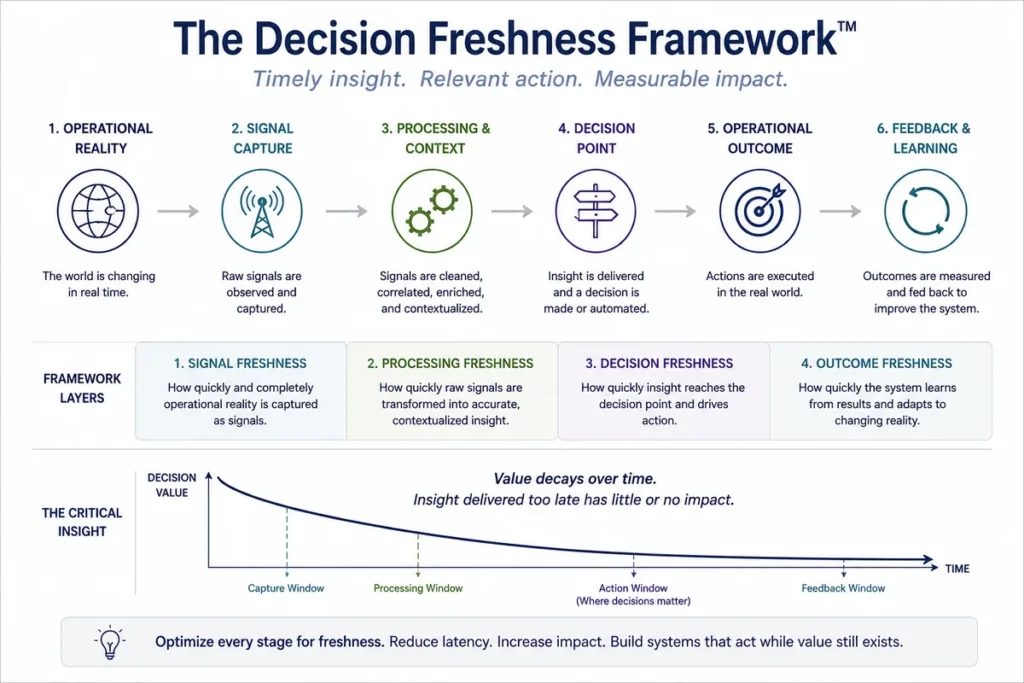
After running into this enough times, I wrote down a framework for thinking about it. I call it the Decision Freshness Framework, and the core idea is simple: in modern operational AI, timing isn’t a performance nice-to-have. It’s part of correctness.
The idea most dashboards hide from you
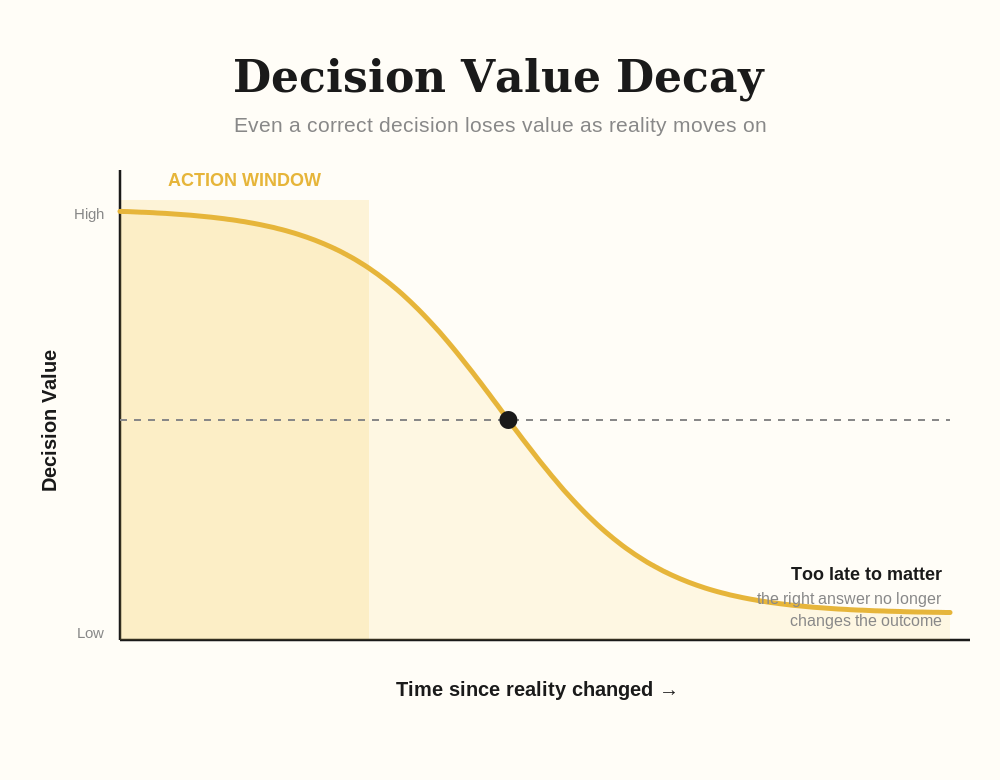
Decision value is not static.
We tend to judge a decision by whether it was accurate. But accuracy assumes the world holds still long enough for the answer to matter. It rarely does. The moment operational reality starts moving, even a perfectly correct decision begins to lose value — and there’s a window where action can still change the outcome, after which the value decays toward zero.
An accurate prediction delivered too late has no operational value. Once you internalize that, the question changes. It’s no longer just “is this right?” It’s “is this still fresh — does it fit inside the window where it can still change something?”
One forward path, one feedback loop
The framework breaks any operational AI system into four layers across one forward path and one feedback loop.
The forward path carries reality through to action:
- Signal Freshness — Did we capture it, completely and fast enough?
- Processing Freshness — Did we turn it into meaningful context in time?
- Decision Freshness — Did it drive action while action still mattered?
The feedback loop keeps the whole thing honest:
- Outcome Freshness — Did we learn whether it worked, fast enough to adapt?
The first three layers determine whether you can make a good decision. The fourth determines whether you can keep making one.
The two ways real-time AI decision making fails
Here’s the part that tends to land hardest. Real-time AI decision making fails in two completely different ways, and most organizations only watch for one of them.
Too slow. Latency piles up across Signal, Processing, and Decision until the right answer arrives after the window has closed. This is the failure everyone instruments for — there’s a dashboard for it.
Quietly wrong. The forward path stays fast, but a weak feedback loop lets the system drift out of calibration as reality shifts. It keeps producing fast answers that are steadily more incorrect, and nothing flags it. The dashboard is green. The model looks healthy. And it’s quietly rotting.
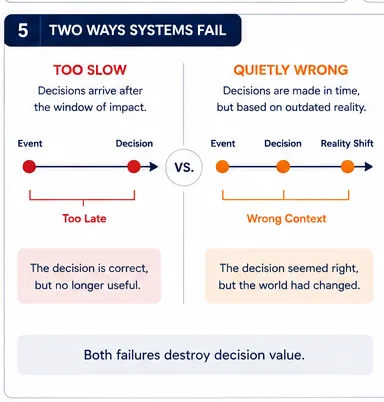
Think about the last time your card got declined for suspected fraud with no warning — it had been swiped across town earlier that day. From your side, everything looked fine. No alert. That’s not a speed failure; the system was plenty fast. It’s a feedback failure, and it’s the one almost nobody is watching.
The uncomfortable truth: fast-and-wrong feels exactly like fast-and-right, right up until it doesn’t.
What makes real-time AI decision making actionable
A framework that only describes isn’t worth much. Two rules make this one prescriptive:
- The forward path is weakest-link-capped. You can’t be fresher at Decision than your Signal layer allows, so find the binding constraint first and fix it there. (It’s rarely the model.)
- Outcome is a gate, not a link. A weak feedback loop doesn’t slow you down — it lets fast, accurate decisions quietly rot into fast, wrong ones. The question isn’t “is this the bottleneck?” but “is the loop open or closed?”
Find your binding constraint, and keep your loop closed. That’s the whole discipline.
Get the full framework
The complete write-up goes deeper on each layer, the difference between data drift and concept drift, and six practical ways to actually close the feedback loop — plus the full visual set you can reuse with your own team.
Download the free framework here! Just enter your email and I’ll send the PDF and the diagrams straight to your inbox.
Because in real-time AI decision making, correctness isn’t a destination. It’s a continuously moving target — and the organizations that win will be the ones that notice when their understanding of reality has changed, and adapt before decision value erodes.
