
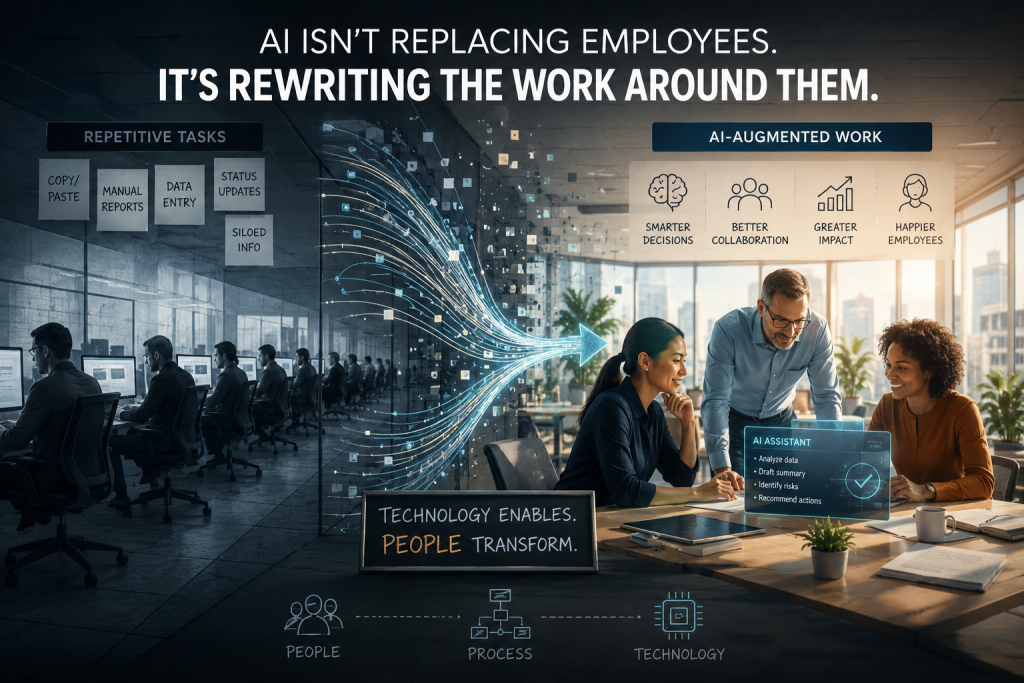
About a year ago, it was difficult to attend an AI conference, open LinkedIn, or read anything about technology without hearing the same prediction. Artificial intelligence was going to replace millions of workers. Entire professions were expected to disappear. Organizations that moved quickly would operate with significantly fewer employees than they did before. This post is not to say I’m predicting this will never happen, but it is here to say that I think it’s going to take a whole lot longer than many would have led you to believe. AI isn’t replacing employees. It’s rewriting the work around them.
The message was compelling because it was easy to understand. If AI could write software, answer customer questions, summarize documents, generate marketing content, and analyze data, then it seemed only logical that companies would eventually need fewer people to perform those activities. Some CEOs even claimed to have bought into it, but to me, it seems to largely be a market move to get attention on Wall Street and cut costs, rather than reshaping the way they do business.
Fast forward to today, and the conversation feels noticeably different.
The Conversation Around AI Work Has Changed
Many of the same technology leaders who once spoke confidently about workforce reduction are now talking about AI agents, digital coworkers, organizational capacity, and helping employees accomplish more. That doesn’t mean concerns about workforce displacement have disappeared. They haven’t. Companies will continue to automate highly repetitive work, and some roles will undoubtedly be affected. What’s interesting to me is not that the technology changed so dramatically, yes, the models are getting better incrementally, but I think it’s that our understanding of the problem has matured.
I don’t believe organizations suddenly became less interested in efficiency. I think they discovered something many enterprise architects have understood for years: implementing technology is usually the easy part. Changing the way an organization actually works is considerably harder.
That distinction is important because I think many of us, myself included, initially framed AI around the wrong question. We asked which jobs could be replaced instead of asking how work itself might change. The difference sounds subtle, but I believe it changes everything.
We Mistook Tasks for Jobs
One of the biggest misconceptions surrounding AI is the assumption that jobs are simply collections of tasks waiting to be automated. They’re not. Jobs are collections of responsibilities that require judgment, context, accountability, relationships, and experience. AI has become remarkably good at completing individual tasks, but enterprise value comes from helping organizations achieve outcomes.
Anyone who has spent time inside a large enterprise recognizes this immediately. Every organization has employees who know why the documented process doesn’t always match reality. They understand the exceptions, the customer relationships, and the historical context that allows the business to function. Much of that knowledge never appears in a process diagram, yet it influences decisions every day.
Think about your best project manager. Their value isn’t that they can update a schedule or send a status report. It’s that they recognize when a project is beginning to drift before the dashboard shows it. They know which executive needs additional context, which customer requires a different approach, and which issue deserves immediate attention before it officially becomes a problem.
The same is true for an experienced customer service representative. They don’t simply answer questions. They recognize frustration before it turns into attrition, understand when policy should give way to common sense, and know how to navigate conversations that no knowledge base could ever anticipate. Those aren’t just tasks. They’re judgment, and that’s why replacing a task is fundamentally different from replacing a job.
That’s why the early narrative around AI replacement was overly simplistic. We treated work like a checklist instead of a system. The more organizations deploy AI into real business environments, the more they discover that work is collaborative, contextual, and full of exceptions. AI can accelerate many parts of a job, but replacing everything surrounding those tasks is a far more complicated proposition.
Reality Is a Tough Customer
I don’t think the AI industry intentionally misled anyone. Quite the opposite. The technology really is extraordinary. What many of us underestimated, or simply closed our eyes to, was the complexity of the organizations we were trying to improve.
Enterprise systems weren’t designed around AI. They were built over decades through acquisitions, reorganizations, changing leadership teams, regulatory requirements, and countless business decisions. Processes evolved, exceptions accumulated, and institutional knowledge often ended up living in the heads of experienced employees rather than in documentation.
When AI entered that environment, it didn’t just automate work. It exposed it.
Organizations suddenly realized they had three versions of the same customer, conflicting definitions of basic business terms, undocumented approval processes, and data spread across dozens of disconnected systems. None of those problems prevented people from doing their jobs because people are remarkably good at filling in the gaps. AI isn’t.
For years I’ve said that successful technology initiatives are ultimately about people, process, and technology, in that order. AI hasn’t changed that principle. If anything, it has reinforced it. The technology is improving at an incredible pace, but the people and process side of the equation is still where most organizations struggle. This is one of the key sentiments around the articles I wrote last month regarding the rise of ontologies.
Why the Conversation Changed
I think that’s why the messaging from many technology leaders has shifted over the past year.
Klarna became one of the first organizations to demonstrate just how much AI could transform customer service, announcing that its AI assistant handled work equivalent to hundreds of support representatives while dramatically reducing response times. Those results were real, and they demonstrated just how capable modern AI systems have become.¹
At the same time, Klarna didn’t eliminate the need for human support. Customers can still speak with people because some situations require empathy, negotiation, trust, or simply the reassurance that another person understands the problem. AI changed the workflow, but it didn’t eliminate the value of human judgment.²
Even Sam Altman has recently acknowledged that the widespread white-collar job losses many feared have not materialized in the way he once expected.³ That’s not an admission that AI is less capable. It’s recognition that organizations are far more complicated than the original narrative suggested.
Microsoft has also begun shifting the conversation toward organizational capacity rather than personal productivity, and I think that’s an important distinction. Saving an employee twenty minutes writing an email is interesting, but helping an organization serve twice as many customers, process claims faster, shorten development cycles, or reduce operational bottlenecks is transformational. Those aren’t simply productivity improvements. They’re operating model improvements that fundamentally change what the business is capable of accomplishing.⁶
Rewriting the Work
I suspect this is where the next phase of enterprise AI will be won.
The organizations creating the greatest value from AI won’t simply hand every employee another AI assistant and hope for the best. They’ll rethink how work moves through the business. Instead of asking employees to collect information from five different systems, workflows will assemble the information automatically. Instead of routing every routine decision through layers of management, AI agents will handle common approvals while escalating only genuine exceptions. Documentation won’t become another task to complete at the end of the day. It will become part of the process itself.
Notice what changed in those examples. The employee didn’t disappear. The work changed, and that’s a much more significant transformation than helping someone draft an email faster or summarize a meeting in half the time. It requires organizations to rethink processes that may not have changed in years, integrate systems that have never communicated effectively, improve data quality, establish governance, redefine responsibilities, and help employees adopt entirely new ways of working. None of those challenges are solved simply by deploying a better language model. They’re leadership challenges that happen to involve technology.
This is one of the reasons I’ve never been convinced that measuring individual productivity tells us very much about the success of an AI initiative. Saving an employee twenty minutes every day may sound impressive, but unless that time translates into better decisions, higher quality, faster execution, or improved customer experiences, the organization hasn’t really changed. The real value comes when AI enables the business to operate differently, not just when it allows individuals to work a little faster.
The Leadership Opportunity
I think that’s the lesson many organizations have learned over the past two years. The companies creating the greatest value from AI aren’t necessarily the ones with access to the newest models or the largest budgets. They’re the ones asking better questions.
Instead of asking, “How many jobs can AI replace?”, they’re asking, “How should this organization operate now that AI is part of the team?” That shift fundamentally changes the discussion. It moves leaders away from thinking primarily about labor reduction and toward improving customer experience, redesigning workflows, strengthening governance, accelerating decision-making, and creating competitive advantage. In other words, the conversation becomes less about the technology itself and more about the business the technology is intended to improve.
AI will undoubtedly reshape the workforce. Some roles will disappear, others will emerge, and many more will evolve in ways we can’t fully predict today. Every major technological shift has followed a similar pattern. What I find far more interesting, however, is not the number of jobs that change, but that organizations are being forced to rethink how work should happen in the first place.
To me, that’s the real story. AI isn’t replacing employees nearly as often as the early headlines suggested. It’s challenging long-held assumptions about how work flows through an organization, where decisions should be made, and what responsibilities should remain uniquely human. The organizations that recognize that distinction will create far more value than those focused exclusively on reducing headcount, because they’ll understand that successful AI initiatives have never really been about replacing people. They’ve always been about redesigning the way people, processes, and technology come together to achieve better business outcomes.
AI isn’t replacing employees. It’s rewriting the work around them.
References
- Wall Street Journal: Tech CEOs Ditch the AI Jobs Apocalypse Narrative.
- Reuters: OpenAI’s Sam Altman says AI unlikely to lead to a “jobs apocalypse.”
- Associated Press: AI is reshaping call centers through task redesign rather than wholesale replacement.
- McKinsey & Company: The State of AI reports emphasize that organizations are capturing value by rewiring workflows and operating models, not simply deploying AI tools.
- Research: Generative AI and the Reorganization of Labor Demand finds firms are adjusting through both hiring changes and redesigning tasks within jobs.
