Your AI Is Fast, Accurate, and Too Late
An accurate prediction delivered too late has no operational value. The Decision Freshness Framework reveals the four layers that decide whether your systems act while action still matters — a practical model for real-time AI decision making.
Download Free Framework
Join technology leaders putting timing first
The Decision Freshness Framework
12 pages · Complete visual set included
Your dashboards are real-time. Your decisions are late.
We generate more data every day than at any point in history. Dashboards refresh in near real time, models process millions of records — and yet most organizations are less responsive operationally, not more.
The frustrating truth? In most cases, the model isn't the problem.
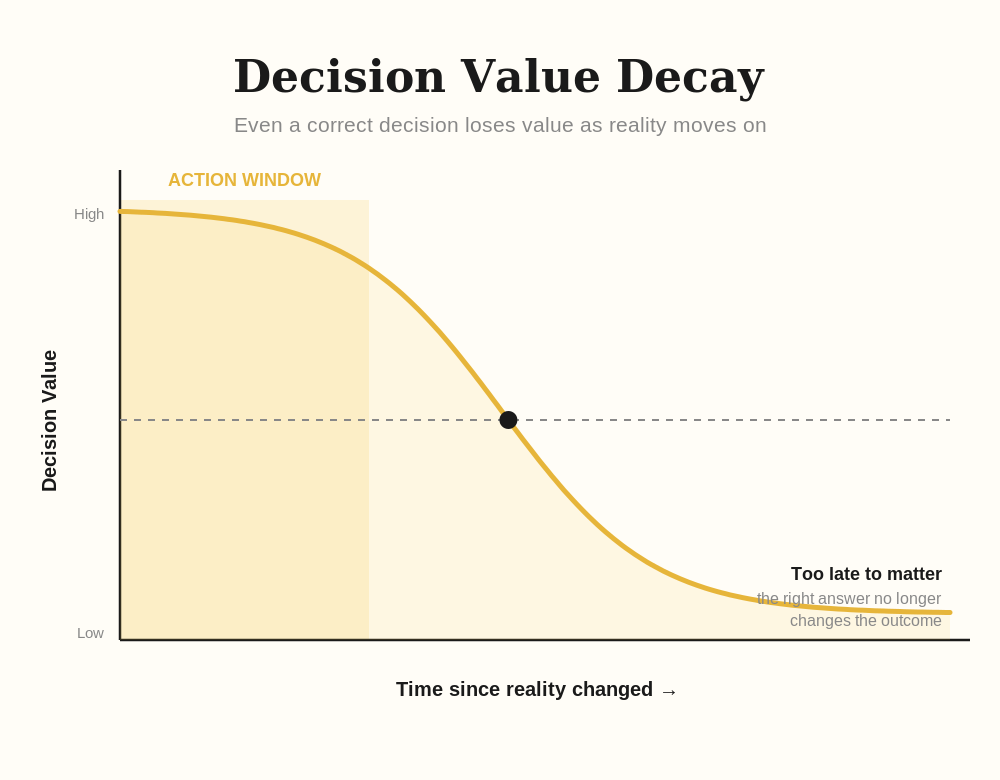
Recommendations arrive after behavior changed. Fraud flags fire after the transaction cleared. Even a perfectly accurate decision starts losing value the moment operational reality moves on — there is a window where action still changes the outcome, and after it closes, the answer no longer matters.
Miss that window and the system fails silently: fast, confident, and increasingly wrong, with nothing on the dashboard to show it.
One Forward Path. One Feedback Loop.
The Decision Freshness Framework organizes any operational AI system into four layers — measuring how fast operational reality becomes action, and how effectively outcomes become learning.
-
1
Find Your Binding Constraint
The forward path is only as fresh as its weakest layer. Learn why fixing the wrong one returns nothing.
-
2
Tell Slow from Wrong
Diagnose which of the two failure modes you actually have: too slow, or quietly drifting out of calibration.
-
3
Close the Feedback Loop
Apply six concrete practices that keep decisions correct over time, not just fast today.
-
4
Catch Silent Drift
Build the feedback most teams skip and see the failure no dashboard shows you — before it reaches customers.
Everything Inside the Framework
A practical model, diagnostic questions, and implementation guidance. Not theory.
Root-Cause Timing Diagnosis
Why a late decision almost always originates in an earlier layer than you think, and how to trace it to the binding constraint.
The Four-Layer Model
A complete mental model for how signal, context, action, and learning connect into one operational system.
The Two Failure Modes
The difference between "too slow" and "quietly wrong," and why most organizations only instrument for the first.
Six Ways to Close the Loop
A practical playbook for Outcome Freshness — from defining the real outcome to retraining on purpose.
Data Drift vs. Concept Drift
How to separate the two failures that wear the same costume, so your feedback system fixes the right one.
The Two Governing Rules
The weakest-link cap and the outcome-as-a-gate rule — how to decide where to invest and what to leave alone.

Ready to Stop Shipping Decisions That Arrive Too Late?
Get the framework that helps technology leaders find the one stale decision hiding in their stack — and keep every decision timely and correct as reality changes.