
AUGUST 2026 • ENTERPRISE DATA & AI BRIEF

A year ago, nearly every conversation about artificial intelligence seemed to revolve around one question: Which jobs are going to disappear? Depending on who was speaking, the answer was either “almost none” or “you should probably clean out your desk by Friday.” Every model release triggered another round of confident predictions from people who had never tried to get an enterprise purchase order approved.
Then something funny happened. The replacement language began to fade. Companies started talking about copilots, agents, digital coworkers, frontier firms, productivity, and workflow redesign. Apparently, replacing an employee turned out to be more complicated than asking a chatbot to write a quarterly update.
The technology improved, of course, but reality also caught up with the story. A job is not a single task with a salary attached. It is a messy combination of experience, judgment, relationships, institutional knowledge, communication, and dozens of small decisions that never appear in the process diagram. The diagram, naturally, says the process is perfectly linear. The people doing the work know better.
That is why I think we have been asking the wrong question. Instead of asking whether AI will replace a job, we should ask something much more useful: What happens when AI begins performing the parts of the job that used to consume most of our time?
The job is not the unit of change
The most useful research increasingly looks at work at the task level. In 2025, the International Labour Organization and Poland’s NASK estimated that one in four jobs worldwide was potentially exposed to generative AI, and I’m sure much higher as we make our way through the rest of 2026. The important word is “exposed.” It means AI may affect some of the work inside the job. It does not mean one in four people will be escorted from the building by a robot.
The researchers reached a more nuanced conclusion: transformation is more likely than full replacement. That is less dramatic than the headlines, but it is far more useful for anyone who actually has to run an organization. I’m also now hearing more customers refer to “not growing” staffing levels, but instead making their current staff more productive.
I call this pattern the Task Shift.
| THE TASK SHIFT – AI increasingly performs routine execution while people spend more of their time applying judgment, context, communication, exception handling, and decision-making. |
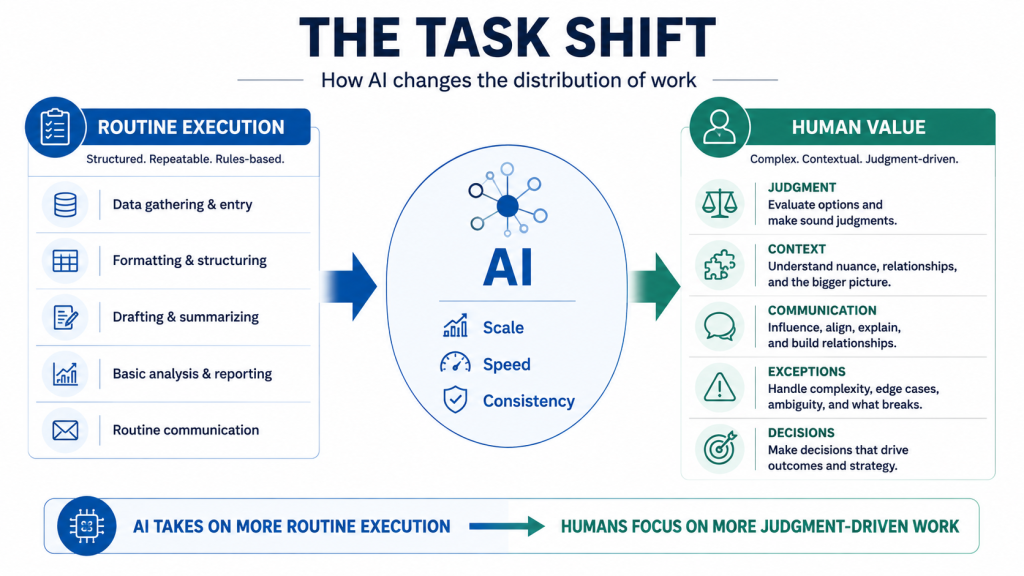
This is not a clean handoff where machines do the boring work and people spend their afternoons being strategic. AI can generate creative options, identify patterns, and draft recommendations. Meanwhile, plenty of highly paid humans will continue copying (and transposing) numbers between spreadsheets because the systems still do not talk to each other. Technology has a sense of humor.
The point is that the center of gravity moves. When producing an answer becomes faster and cheaper, the scarce contribution is deciding what question to ask, whether the answer is trustworthy, what tradeoff is acceptable, and who is willing to own the result.
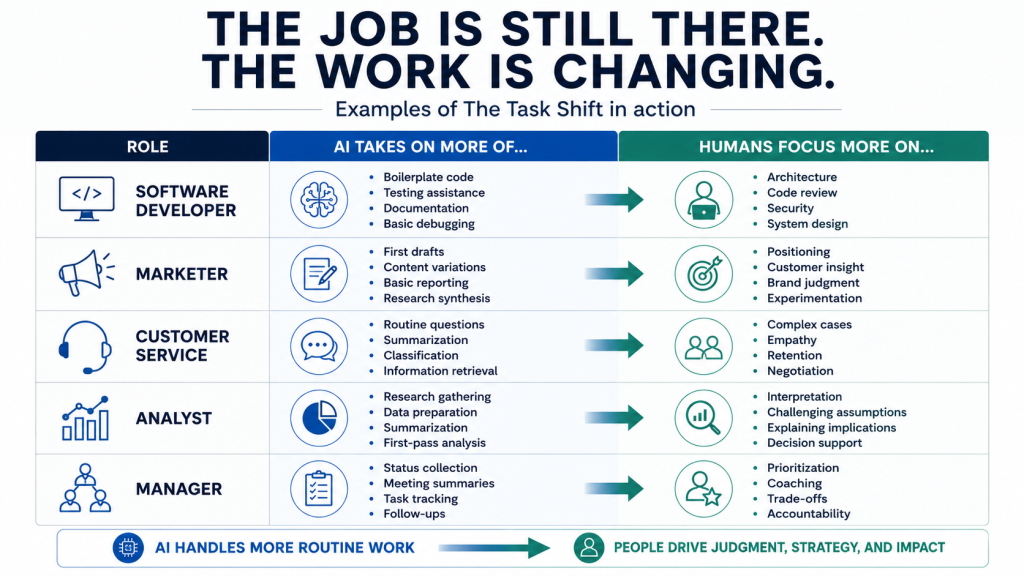
What the Task Shift looks like in practice
The developer who can produce ten times more code
Imagine a development team that uses AI to generate boilerplate code, tests, documentation, and first-pass fixes. Output goes up. Everyone celebrates. Then code review becomes the bottleneck, the security team finds a dependency nobody checked, and three services implement the same business rule differently. The company did not eliminate engineering work. It moved the work from typing code to deciding what belongs in the system and proving that it will not break everything around it.
That makes architecture, integration, security, observability, and review more valuable. It also makes “lines of code produced” an even sillier measure than it already was.
The marketing team with unlimited content
A marketing team can now generate fifty subject lines, twelve campaign concepts, six audience variations, and enough social posts to make everyone mute the company by lunch. The constraint is no longer producing content. The constraint is having something worth saying.
Positioning, customer insight, taste, experimentation, and brand judgment become more important because AI is very good at creating competent material that sounds exactly like competent material. The marketer who knows what should not be published may create more value than the one who produces the most drafts.
The support operation that automates the easy calls
AI is well suited to retrieving policy, classifying requests, summarizing histories, and answering routine questions. In one widely cited field study, AI assistance increased customer-support productivity by about 14 percent on average, with the largest gains among less experienced workers. That is meaningful.
But look at what remains after the easy cases disappear. The human agent gets the furious customer, the policy exception, the account threatening to leave, and the issue caused by three systems disagreeing about what happened. The average case handled by a person becomes harder. If management keeps the old handle-time target, it will punish employees for doing precisely the work the company still needs them to do.
The analyst with a beautiful, completely wrong answer
AI can write a query, summarize a dataset, build a comparison, and produce a confident narrative about a chart. It can also analyze the wrong population, misunderstand a business definition, or turn a data-quality problem into an executive-ready slide. But hey… the formatting will be excellent!
The analyst’s value shifts toward challenging the premise, tracing lineage, recognizing what is missing, testing alternative explanations, and connecting evidence to an actual decision. Generating an insight is useful. Knowing whether the organization should act on it is the job.
The manager who finally has fewer status reports
Agents can summarize meetings, draft plans, compile updates, and chase routine follow-ups. Good. Most organizations have enough status reporting to qualify as a separate industry.
None of that tells a team what not to do, resolves a conflict between two strong performers, coaches someone through failure, or accepts accountability for an unpopular call. AI may reduce the administrative work around management. It does not remove the need to manage.
These examples and more prove over and over that AI is really good at the things your computer is really good at, it is just faster at processing an analyzing the information. The interpretation is where AI breaks down in some cases, as AI struggles with the unpredictability of human behavior. In large part, humans still need to interface with humans for many situations to get proper resolution.
The problem hiding underneath the productivity story
There is a complication inside this otherwise encouraging argument. Organizations have traditionally developed senior professionals by giving junior professionals foundational work. Junior analysts gathered and cleaned data before they learned which data mattered. New developers fixed small defects before they designed systems. Early-career consultants built the appendix before they challenged the recommendation. Junior lawyers fresh out of law school poured over book after book and brief after brief.
Much of that work was repetitive. Some of it was tedious. A fair amount of it existed because senior people did not want to do it. Still, it created pattern recognition. Doing it exposed people to edge cases. It let them make small mistakes while the stakes were low and a more senior person was watching over their shoulder. It also created confidence and expertise that can only be developed with repetition and interpretation.
If AI performs more of the foundational work, where does the judgment come from?
The evidence gives us reasons for optimism and caution. AI can make expert-like guidance available to newer workers, and the customer-support study showed that less experienced employees gained the most. At the same time, the ILO’s 2026 evidence review warns about erosion of opportunities for younger workers. Both things can be true. AI can help a beginner perform better today without ensuring that the beginner becomes an expert tomorrow. I’ve also heard from many that have started a new job with a new company how the tools in their organization that have the connected data and context are able to be more proficient in their role that much quicker.
This is the difference between assisted performance and actual capability. An employee can produce a polished recommendation by accepting the model’s answer. The more important test is whether that employee notices when the answer is wrong, incomplete, or inappropriate for the situation. “The AI said so” is not a development strategy, and it is definitely not an accountability model. Personally, I’m still a long way from moving past the “trust but verify” model.
Redesign the work, not just the toolset
The answer is not to preserve tedious work out of nostalgia. Nobody needs a museum of manual status reports. The answer is to redesign the workflow and the development path at the same time.
1. Map the work people actually do
Break a role into routine execution, analysis, interaction, judgment, and accountability. Then identify what AI can perform, what it can assist, and what must remain under explicit human ownership. Do this with the people who perform the work, not only with the process diagram. The exceptions are usually where the real job is hiding.
2. Change the quality standard
If AI makes first drafts cheap, “produced a first draft” is no longer much of an accomplishment. Measure whether the problem was framed correctly, the output was verified, the decision improved, and the outcome mattered. A faster wrong answer is not productivity. It is just a more efficient way to create a problem.
3. Make the reasoning visible
Ask employees to explain assumptions, evidence, alternatives, and confidence. Review how they reached the answer, not only how polished the final document looks. Use difficult exceptions as teaching material. If all you inspect is the output, you cannot tell the difference between someone who understands the work and someone who found the right prompt.
4. Build deliberate practice into the role
Create simulations, shadowing, rotations, and progressively harder decisions. Let AI coach junior employees, but also test whether they can challenge a recommendation and operate when the tool is unavailable. People need a safe place to build judgment before the organization asks them to exercise it with real consequences.
5. Name the person who owns the decision
For consequential work, human review cannot be a ceremonial click added to satisfy a governance checklist. The reviewer needs context, authority, and enough time to disagree. If nobody can explain who owns the outcome, the workflow is not automated. It is unattended.
What makes you valuable now
The World Economic Forum expects demand for AI and data skills to rise quickly, but it also emphasizes analytical thinking, resilience, leadership, and collaboration. That combination matters. The future does not belong only to the person who understands the technology, or only to the person with vaguely defined “people skills.” It belongs to people who can use powerful systems while supplying the context, standards, relationships, and accountability those systems do not bring with them.
The most important question is no longer, “Will AI take this job?” It is, “As AI takes on more execution, what should the person in this role become exceptionally good at?”
That is a better workforce question. More importantly, it is a better business question.
| A QUESTION FOR YOUR NEXT LEADERSHIP MEETING: Choose one role. List the tasks AI can perform, the decisions people must still own, and the experiences required to develop the next expert. The gap between those lists is your real AI transformation agenda. |
Selected sources
Microsoft 2026 Work Trend Index
World Economic Forum, Future of Jobs 2025
Anthropic Economic Index (2026)
