
By Chris Seferlis • October 2026
Knowing the business comes first
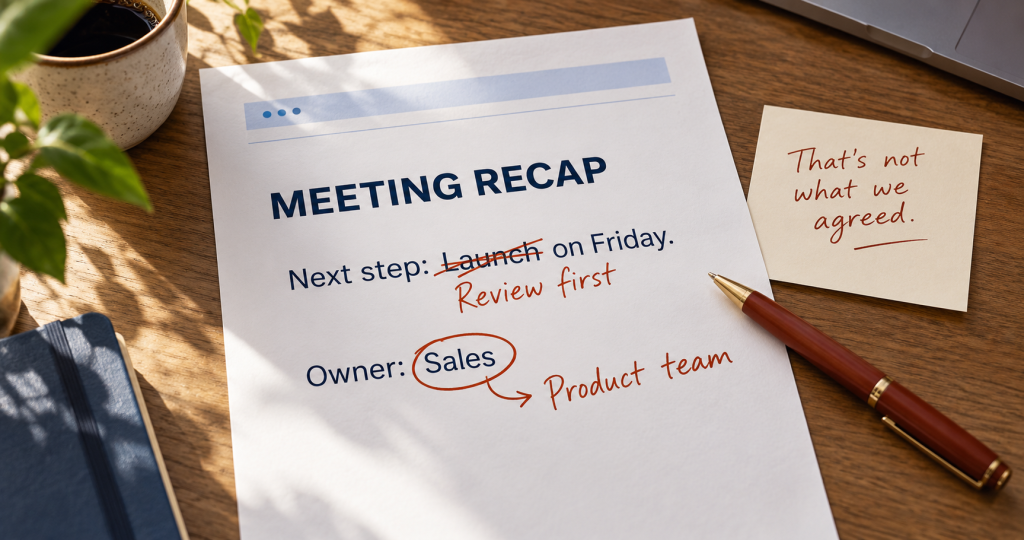
Using AI effectively requires someone who understands how the organization runs. Knowing the customer, architecture, financial model, regulations, history, politics, data, or business process helps us know what questions matter in the first place and recognize when the answers are wrong. With AI, we can certainly throw together a vibe-coded app, meeting summary, or blog in seemingly no time at all. But when is the last time you looked at a meeting recap right after your meeting and said to yourself, “uh, that’s not what the follow-up was”? Here is where the differentiation of humans becomes real and why I believe it’ll be a long time before AI has all the negative effects all the prognosticators believe are coming.
There is also a question of the importance of the output we need. We measure success very differently when we’re looking to spin up a new website for personal fitness tracking versus putting together a brief for an escalation to senior management. How often have you found yourself fighting iteration after iteration when the LLM takes you down a path you never intended? You’ve been fighting with the tool for so long, you can’t help but wonder if you would have been better off not using AI at all. I’ve had AI “draw” a table in PowerPoint, including each line, instead of just creating a formatted table with the information. Now try editing that. It’s a colossal pain!
Alternatively, that website I whipped up in a few minutes, then got step by step instructions to publish and host, took me maybe an hour. That’s a game changer. And it looks pretty good to boot! If I had to do that by hand, or even use one of those website generation tools, it could take hours to put something together I actually like. The difference in experience from one use case to the next is dramatic. There are countless use cases where AI has made my life easier and saved hours of time… meanwhile, I could also point to countless use cases where if I had just sat down and focused on the work, it would have been done much quicker.
Given the choice, I’m going to use AI depending on the stakes of the task. When it’s helping me pick my fantasy football lineup, I’m not going to be too discerning about its recommendations. When I’m putting together a brief for a senior manager, I may use it as a starting point, but there will be a significant amount of checking and editing before I hand it in.
Experience shapes judgment
So, we’ve established that the tools come with a caution sign saying “expect mixed results”, but why does there even exist a conversation about AI causing mass layoffs and economic disruption? Statistics from earlier this year show that straight out of college graduation hiring rates compared to overall unemployment are the lowest since just after the great depression. With concerning statistics like that, it’s no wonder the question that keeps coming up, personally and across the media, is whether a junior associate, developer, or sales rep using AI can be successful and gain domain expertise without going through the intricate details of learning their craft. In this world where we just need to “get stuff done,” with constant pressure to perform, it’s tempting to rely on the tools. But the tools, as we’ve already established, are fallible. Starting in IT almost 30 years ago, I can still remember the painstaking process of fighting through technology problems, diagnosing system errors, and performing hundreds of system upgrades and builds, with many mistakes along the way. An upgrade might appear successful because the system came back online, only for us to discover that a process people depended on no longer worked. That’s the kind of experience that teaches you to ask more than “did the upgrade finish?” You learn to ask, “can people still do their jobs?” Would I have been as effective as a leader and manager without that experience, without having been in their shoes? I’d argue that it’s highly unlikely. Experience matters. AI can help someone work through a technical problem, but we still need opportunities to develop the judgment to recognize when a seemingly good answer misses what matters.
Critical thinking means checking the work
In my work in education, we’ve adopted a process where students have to lay out their line of reasoning when using AI to assist with assignments. For instance, they walk through the prompts they used, explain why they changed them, and show how they checked the eventual output. The point is for students to demonstrate how they worked through the problem, what they questioned, and why they believe the answer is trustworthy.
Using that logic, how could we apply a similar approach to enterprise? We’ve seen too many examples of wrong information provided by AI being handed in as if it were perfect, with ramifications when the mistakes are caught. When AI provides sources, that gives us somewhere to start. But if we don’t review those sources and confirm they support the claims, how can we be sure the AI didn’t get confused?
We would all love for the easy button to be asking a question, taking the answer for gospel, and moving on to the next task. That’s just not the reality today. For the time being, it makes sense to set some parameters: “You’re welcome to use AI for this, but we need to see how you validated your output.” For a brief going to senior management, that could mean checking the cited sources, confirming the numbers, and identifying anything you couldn’t verify. Trust but verify.
Curiosity creates opportunities
“Growth Mindset.” “Think Different.” “Learn it all, not know it all.” “Be Curious.” Do any of these sayings sound familiar? The theme is consistent: there is value in asking “Why?” With AI, we’re talking about the next level of satisfying curiosity.
I have an endless list of things that I want AI to help me develop, teach me, and just generally do some cool stuff in my life. Working on research, application development, travel itineraries and mundane task completion just to name a few. Having all these possibilities at my fingertips is incredible, and I will never be bored again. That could be a good or bad thing, but hey, maybe it’ll help me develop a better creative and meditation practice. There are so many ways to use these tools that I think we sometimes forget how great they can be. AI won’t do all the work, but it can help us explore areas where we lack knowledge and give us more ways to work through an idea.
That same curiosity has value at work. The World Economic Forum’s Future of Jobs Report 2025 identifies curiosity and lifelong learning among the core skills employers value. Think about a report your team puts together every week. Before asking AI to produce it faster, ask why the report exists. Who uses it? What decision does it help them make? Which parts are useful, and which are there because we’ve always included them? Countless times I’ve seen examples where a report was produced and no one even used it! AI can help you explore those questions and develop a different approach, but you still need to talk to the people using the report and test whether the change actually helps. Maybe the opportunity is to make the report shorter, change what it measures, or stop producing it altogether.
The curious employee is willing to question how the work gets done, explore an alternative, and check whether it’s better. Let’s embrace that opportunity alongside summarizing meeting notes and emails from the day to get more value from the tools.
Communication turns information into action
One of the major themes I’m seeing come out of education when it comes to AI is that students need to improve their soft skills as they get closer to the start of their careers. Strong communication has always been an asset for high-performers, leaders, managers, and executives. AI unlocks an incredible amount of information for us to learn from, if we’re willing to take the time. When you couple that with strong communication skills, superpowers unlocked!
But having the information doesn’t mean we’ve communicated it well. Think about that brief going to senior management. AI can help organize the information and make it sound polished, but someone still needs to explain what matters, what remains uncertain, and what decision needs to be made. If a senior manager challenges the recommendation, can you explain why you stand behind it?
The same goes for an email to a colleague or customer. AI doesn’t automatically know the relationship you have with that person, what happened in your last conversation, or why a particular phrase might land the wrong way. Knowing the information is one thing. Knowing how to communicate it to the person receiving it is where your experience and judgment come into play.
Leaders should value outcomes and accountability
Our organizations need plans to develop their people and maximize the use of the tools as well. Are there skilling plans in place to help employees get value from the investments that have been made in AI tools across the company? Are there measurable results being tracked? What about improving soft skills as part of those plans?
Those results should tell us more than how often someone opens an AI tool. Is the work more accurate? How much time are we saving with all the iterations included? Can the employee explain the recommendation and recognize when the output needs to be challenged?
Microsoft’s 2026 Work Trend Index provides some useful context. Among the AI users surveyed, quality control of AI output and critical thinking topped the list of human skills respondents said were becoming more important as AI took on more work. That’s a signal about what workers believe matters, rather than proof that using AI makes someone a better thinker.
The familiar question of “how much will it cost me to train my people?” takes on more weight with all these tools becoming available. “How much will it cost if we don’t?” People need to know how to use the tools effectively to perform their tasks efficiently and take on more work, as that’s what’s being asked of all of us. They also need opportunities to keep developing the expertise that helps them check the work.
It will simply be unacceptable for an agent to take a wrong path or make a wrong decision and for the human overseer to point the finger at the agent for the wrongdoing. This is a core principle of Responsible AI: accountability.
That responsibility needs to be clear before the work is delegated. What can the agent do on its own? What requires approval? Who checks the result, and who steps in when something goes wrong? NIST’s AI Risk Management Framework calls for documented responsibilities and defined roles for human oversight.
The same principle applies when an employee uses AI to prepare a brief, write an email, or make a recommendation. “The AI said so” isn’t enough. We need to be able to explain what we checked and why we’re comfortable using the result.
AI fluency becomes a baseline
I’m sure there was a point at which people would have a line on their resume similar to “proficient at using the Internet.” I liken this to some of today’s emphasis on being a good prompter. There was a time when being good at using search engines was a bit of an art. Knowing the secret language to ensure the search highlighted the most important parts of what you asked was paramount to being good at using the tools. But the tools got better, adapted to how people used them, and made it easier to get the desired results.
I expect AI to follow a similar path as it becomes more tightly embedded in our day to day work. Specialized prompting and engineering skills will still have their place, but for many employees, using AI effectively will increasingly become an expected part of the job.
All these areas should be part of your consideration as you embrace the tools for your day to day work. If you’re a manager looking at otherwise identical candidates on paper, but one is much more proficient using AI tools, which are you more likely to hire? I see it becoming a necessary skillset to remain competitive and keep pace with the rapidity of change.
Just using the tools and becoming an AI zombie isn’t the answer either. Being able to produce something quickly only gets us so far. We still need to know whether it answers the right question, whether we can trust it, and what to do with it. Judgment, curiosity, domain expertise, critical thinking, communication, and accountability will all still be sought-after skills, but yeah, you’ll need to be able to use the tools too.
Sources and further reading
World Economic Forum. The Future of Jobs Report 2025 — Skills Outlook. January 2025.
The Job Market for Recent College Grads in 5 Charts – Inside Higher Ed. June 2026.
